
Book Review – January 2022
It was an enchanted palace, She must try to find a way in! It was bound to be full of curious passages and doorways – and she must get in. It looked so extraordinary that Unn forgot everything else as she stood in front of it. She was aware of nothing but her desire to enter.

The Ice Palace is set in a village in rural Norway. Siss is a happy, outgoing 11-year old. She is popular with the other children at her village school and leads all the games in the playground.
A new girl arrives at the school. She is called Unn and is also 11-years old. Her mother recently died and her father was never around, so she has come to live with her auntie in a cottage on the outskirts of the village. On Unn’s first day ay school Siss and the other children try to encourage her to join with them in the playground, but she politely declines. Unn prefers to stand on her own away from the group, sometimes watching them at play but mostly just gazing absently at the wall.
Siss is both puzzled and beguiled; she feels some kind of deep connection with Unn, but does not understand what it means. She is aware, however, that Unn steals the occasional glance in her direction, as if aware of their connection, though she continues to remain detached from Siss and her group of friends. Every day Unn stands alone. She seems to embody, it occurs to Siss, a strangely serene inner strength.
Winter is fast approaching and the talk in the playground is of the ice palace, a local natural wonder that returns each year as the temperature drops. The palace is situated at a waterfall upriver from the village. Each winter all but the fast-flowing core of the falls freezes over forming spectacular castle-like ice formations. The ice palace attracts visitors from all over the district in the winter months and is a source of fascination for the children.
After several days of remaining silent, Unn approaches Siss and invites her to visit her at her auntie’s house after school. Both of them seem to feel the need to talk. After chatting briefly with Auntie, the girls go up to Unn’s room. They say very little, each of them unsure what to say, but they tacitly agree that there is a bond between. A strange, mystical atmosphere seems to hold them in thrall. Unn talks about her auntie, her mother and the father she has never met; all she knows is that he was handsome and had a car. At Unn’s suggestion, they gaze at a mirror together. Something seems to fill all their senses:
They let the mirror fall, looked at each other with flushed faces, stunned. They shone towards each other, were one with each other; it was an incredible moment.
But still, they find it difficult to express what they are feeling. Unn confesses that she has something she needs to share with Siss and tells her that ‘I’m not sure that I’ll go to heaven’. Siss is overwhelmed, too many emotions are rising and bursting out of her at once. She does not want to hear Unn’s confession, not yet anyway. She decides she needs to leave. Unn is reluctant to let her go at first, but eventually steps aside and allows Siss to do so.
The next day at registration Siss is dismayed to find that Unn is not there. Unn left for school as normal, but felt overwhelmed about seeing Siss again after the previous evening and decided to take the day off. She walks upriver and over the frozen lake in search of the ice palace. When she arrives she finds herself enchanted by its beauty. She enters an icy buttress of the palace through a small fissure and explores one gleaming chamber after another. Gradually Unn becomes lost and disorientated and is seemingly unaware of how cold she is becoming, and even discards her coat.
Unn does not return and, for the next few days, the whole village is out searching for her. They go to the falls, but find no sign of her. Siss is bereft with feelings of loss and guilt. She shuts out everyone: her parents, her teacher and her schoolfriends. It is as if she is trapped within her own ice palace. Her friends try to reach out to her, but she turns away from them. In the school yard Siss refuses to join in with their games but just stands, silently where Unn once stood.
Siss fears that Auntie will blame her for Unn’s disappearance, but she knows she must go to see her. As it turns out, Auntie is caring and supportive and Siss feels something within her beginning to thaw. Auntie confides that she has decided to leave the village as nothing remains for her here. A few weeks later she goes and, in her wake, the first signs of spring begin to emerge.
The Ice Palace is a short novel but it carries with it great weight and depth from Vesass’s lyrical prose and his subtle layers of allegory. He handles the themes of love, loss, change and sexual awakening with great sensitivity and finds a way to convey the complex feelings of people who do not have the words to express those feelings. In Vesaas’s hands, the Norwegian landscape in winter is a constant, icily evocative backdrop. This is a novel that is as relevant today as it was when it was first published nearly sixty years ago.
Tarjei Vesaas
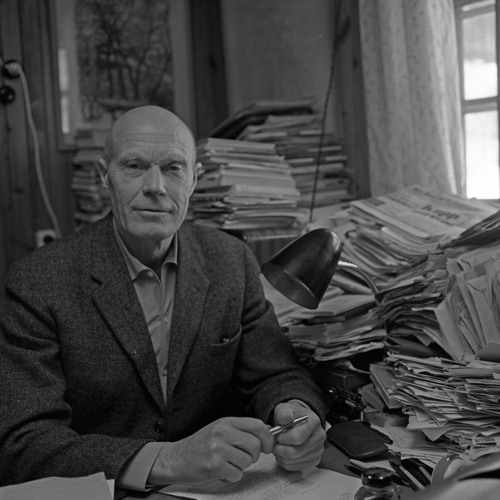 Vesaas was born in Vinje, Norway in 1897 and died in Oslo in 1970. He is widely regarded as one of Norway’s finest writers and wrote novels, short stories, poems and dramas about loneliness, lack of communication and of growing up. His breakthrough came with the allegorical Kimen in 1940 and he is best known for his later novels Fuglane (1957) and Is-slottet (The Ice Palace) (1963).

That’s another one I have ordered on the strength of your review. Thanks Bobby
I sincerely hope you’re not disappointed, Sandy. I don’t think you will be!
This sounds so powerful and unsettling. Remember Annabel said you should submit it to her NordicFINDS project? https://annabookbel.net/nordic-finds-is-here-are-you-ready
Thanks Liz. On a related Nordic point, I’m surprised nobody involved in that project has mentioned Sjöwall and Wahlöö’s Martin Beck Swedish detective novels from the 1960s and 1970s. I read all ten of them about twenty years ago and they’re tremendous police procedurals, years ahead of their time.
I think I saw something about them in one of the posts recently?
I am afraid my reading of The Ice Palace is somewhat different. Let’s start with the obvious: that Vesaas could write. The fatal scene in the ice palace itself is a breathtaking display of virtuosity and throughout the book Vesaas’s gift for lyricism is self-evident. His skilled use of language, however, may be the problem.
When we look beyond style we see a child of 11, not 5, an age where she should be well aware that actions and omissions have consequences, who obstructs a search-and-rescue effort, disregards the suffering of Unn’s aunt, clearly terrifies her cowed and passive parents and, some months after Unn’s disappearance leads her classmates into mortal danger. All of which is narratively legitimate and entirely within Vesaas’s freedom as author.
My problem is that Siss is set up as victim, not as monster. She is shielded by childhood – we can’t interrogate her actions or we, the reader, will ourselves be monstrous and uncaring. The suffering of Unn’s aunt is a foil for Siss’s distress, if distress it is (looks more like a campaign of control to me). Siss’s parents’ passivity is sensitivity rather than a failure of duty and safeguarding. Vesaas presents everything from Siss’s narcissistic perspective and then shields her from any moral interrogation and this, to my mind, is a failure of authorial privilege. Vesaas was an established, mature voice when he wrote The Ice Palace. He knew what he was doing and he manipulates the reader through romanticising Siss’s cruelty and through his use of lyricism which implies that not being beguiled by it means you don’t understand the narrative.
Vesaas also knew what he was doing by framing Unn’s death as the necessary and inevitable consequence of heavily insinuated same-sex attraction (but it’s the reader’s dirty mind, because Vesaas remains pure and takes care to hide behind deniability). This isn’t a novel about all-consuming friendship, it is a homophobic parable without the courage to admit as much. Ironically, this is the only moral judgement Vesaas doesn’t try to evade. His condemnation of homosexual relationships is there on the page.
The Ice Palace, for all its garlands, is a cynical, amoral and reprehensible work that is in need of far greater scrutiny and far less adulation than it has received.
Your idea that this beautiful and complex story is anti-homosexual, cynical, amoral, and reprehensible are your own projections. The Ice Castle is written with language that allows the reader to receive their own symbols, impressions, and aura: coming to their own conclusions.