Book Review – June 2026
To paraphrase Rod Stewart, Wrexham is in my heart, it’s in my soul, it’s my best friend. It shaped me and continues to be a dominant influence in my life – despite the fact that my current house is actually on the border of Flintshire and Cheshire. Wrexham is where I live, if we take ‘living’, as the council did during the City of Culture bid, to mean wherever you ‘work, rest and play’.
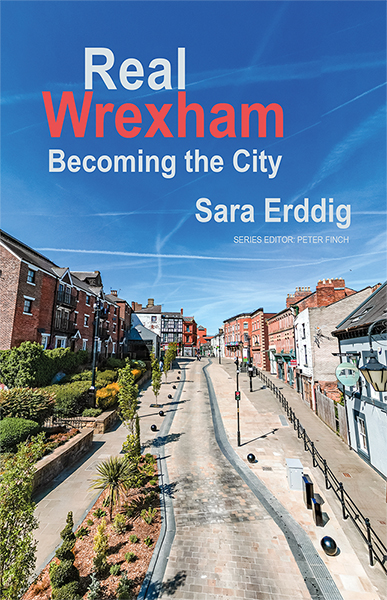
The ‘Real’ series is a collection of books by the Welsh independent publisher, Seren. Featuring an extensive roll call of Welsh, English and Scottish towns and cities, each ‘Real’ title delivers far more than any conventional guide book. Instead each volume concentrates on the quirky and offbeat side of its subject and includes the subjective memories and very personal experiences of its author.
Wrexham has been given the ‘Real’ treatment before, with Grahame Davies’s Real Wrexham published in 2007. Davies’s investigation was comprehensive and insightful. But a lot has changed in the 19 years since his book was published. Wrexham now has a burgeoning arts scene and is a contender for UK City of Culture status in 2029. Wrexham County Borough was also awarded city status in 2022. Furthermore, the name Wrexham has achieved global fame since the city’s football club purchased in 2020 by two Hollywood celebrities, Ryan Reynolds and Rob McElhenney. As well as success on the football field, Reynolds and McElhenney have raised the international profile of the football club and city with an award-winning documentary series, Welcome to Wrexham. Consequently, Wrexham was ripe for a new exploration and review.
Dr Sara Louise Wheeler, writing under the pen name Sara Erddig, is well suited to this task. She was born and brought up in Wrexham and is a leading participant in the city’s Welsh-language cultural scene. Sara chose the surname ‘Erddig’ for this project because Erddig is central to Wrexham’s origin story. The water meadows and woodlands which now form the National Trust’s Erddig estate were occupied by Anglo-Saxon settlers in pre-Norman times. Later, in the twelfth century, the Norman invaders built a castle, Castle Wristleham, in Erddig woods. The castle building is long gone, but the contours of its motte and bailey remain in a place which is now known as Erddig Castle. Sara spent her childhood in a house in a quiet cul-de-sac on the very edge of Erddig’s parkland and recalls its woods and meadows as a place where she and family and friends would walk, play and picnic.
And so I knew that I had found my Ziggy Stardust: Sara Erddig.
In this second edition of Real Wrexham Sara Erddig explores the city of Wrexham in a systematic fashion. The town of Wrexham forms the ‘Central’ section of her dérive. The outlying villages, once part of Wrexham County Borough and now constituent parts of Wrexham City, are visited and discussed as compass point groupings: North, South, West and so on. But this is not a dry travelogue; Erddig approaches her journey through Wrexham in the style of a psychogeographic drift, weaving personal memories and connections into the narrative story of each place she visits. Some places hold very special memories for her: Rhosllanerchrugog, for instance, has significant family connections for her and Fairy Road was the first place Sara Erddig lived after leaving the the family home.
Another village, Coedpoeth, holds darker, more distressing associations for Sara. However, she visits Coedpoeth in the company of Grahame Davies, author of the first volume of Real Wrexham and native of the village. Exploring Coedpoeth with Grahame and seeing it anew through his eyes she discovers a ‘warm, gentle community’ which, although it does not expunge the upsetting memory, helps her to ‘strike a balance’.
Sara Erddig is a fluent Welsh speaker and most of her writing is done in the Welsh language. She is an an active participant in the Welsh-language music and poetry scene and writes at length about this side of Wrexham life. As an incomer to Wrexham and a barely proficient Welsh-learner, this is not a scene that I am familiar with, so I found Sara’s insights sharply illuminating.
The biggest change to the make-up of Wrexham in the past three decades is, I would suggest, in the expanding diversity of its population. Wrexham has had a sizeable Polish population since the end of the Second World War when many of the 26,000 Free Polish servicemen and women who passed through the doors of the Polish military hospital in the village of Penley applied to remain in Wrexham. A second wave of Polish EU migrants arrived in the decade prior to Brexit. The town now has vibrant Polish, Portuguese and African communities many of whom were attracted by plentiful jobs on the Wrexham Industrial Estate, the second largest in the UK, and study opportunities at the city’s university. Sara Erddig touches on this phenomenon, but not in any great detail.
 By a stroke of good fortune, the National Eisteddfod of Wales was scheduled to take place in Isycoed, Wrexham in August 2025, just as Sara Erddig was working on her Real Wrexham project. She devotes several pages of the book to the Eisteddfod and manages to convey the joyous and uplifting nature of the event.
I have to admit that my first thought when I heard about this book was to wonder whether we really needed a re-working of Grahame Davies’s excellent Real Wrexham of 2007. But, having read Sara Erddig’s offering, I’m pleased to say that I get it: this is an excellent and timely book in its own right. Sara’s work is a revealing exploration with much to interest both those who already know Wrexham and those who do not, but would like to know more about this little city with big ideas and an even bigger heart.
Sara Erddig
 Sara Erddig (Dr Sara Louise Wheeler) writes the columns O’r gororau (Barddas) and Synfyfyrion Sara (Golwg360). She won Disability Arts Cymru’s 2022 Creative Words award (Welsh medium) with Ablaeth Rhemp y Crachach – subsequently published in Trawiad | Seizure (2023), and Tu Hwnt | Beyond (2025); this was also released in 2025 as the first single from the album Llaidloffa, by musical collaborative Troi Cerrig. Sara is an artist at Stiwdio Olivet, and a Reader for Fahmidan Journal. A Goareig Patchwork Quilt (Fahmidan, 2024) is Sara’s latest chapbook; her current projects include Fy Wrecsam Amgen | My alternative Wrexham.

Ooh this does look good. I’ve watched the TV series and been interested in the regeneration of the town as much as the football. I love Seren, too, I do an order every now and again so will try to remember to pick this one up.
Thanks Liz. Yes, it’s very good.
Pingback: What I added to my wish list in July 2026 | Adventures in reading, running and working from home