
Book Review – March 2026
Do you know what it’s like to feel wrong twenty-four hours a day? Do you know what it’s like to be disapproved of, not only for what you do and say and think but for what you are?
The first time I heard the phrase ‘cracker factory’ was in the song ‘Two Steps Back’ which featured on The Fall’s 1979 debut album. I was able to discern from Mark E Smith’s dense, inscrutable lyrics that a cracker factory was perhaps some kind of rehab facility:
Cracker factory:A place where you get into the working routine again.Rehabs for no hopesPrefab for jobless dopes.
Two Steps Back – The Fall, lyrics by Mark E Smith
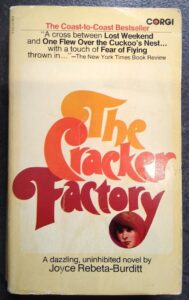
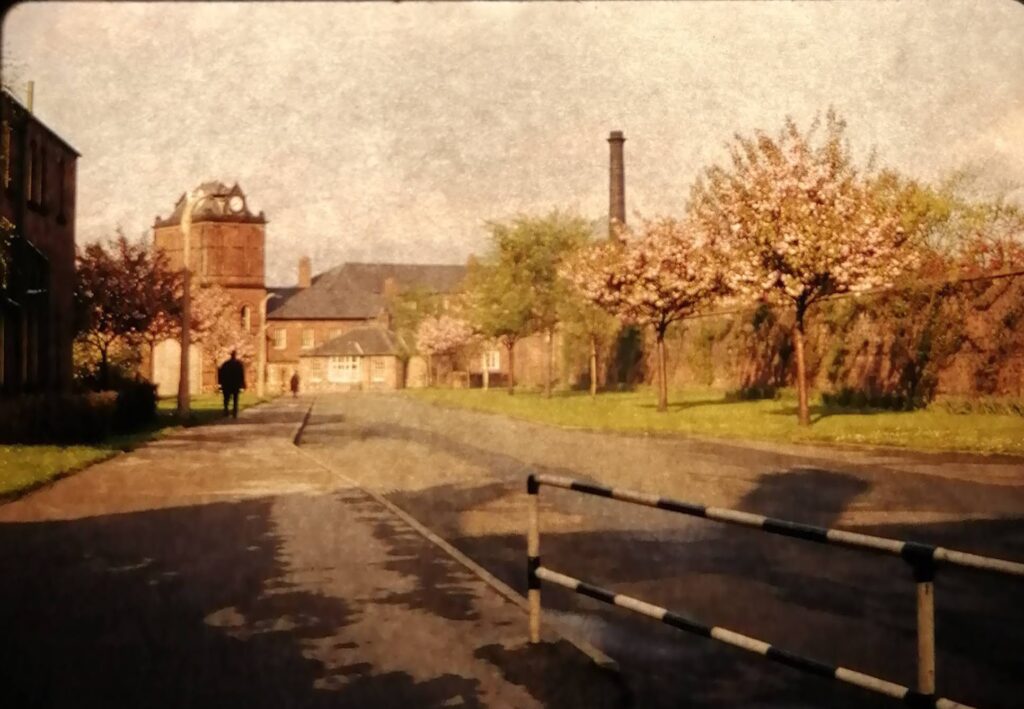
This was in the days before the internet so it was only through a conversation with a friend and fellow Fall fan that I learned, several years later, that The Cracker Factory was a 1977 American novel and the phrase was derogatory slang for a psychiatric hospital. This seemed to make sense in that it chimed with Smith’s love of modern American literature and also with the band’s connection with the psychiatric profession: both Kay Carroll, The Fall’s first manager, and Una Baines, their keyboard player, had trained as psychiatric nurses at Prestwich Hospital.

Una Baines
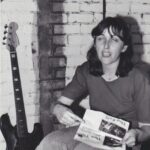
Kay Carroll
I never got round to reading The Cracker Factory back then. Nor did I watch the 1979 TV movie of the same name. In fact, I more or less forgot about it until just recently when, in a charity shop in Chester, I found a 1979 Corgi paperback version of the book, complete with a cover and blurb that were very of their time. In fact, the front cover boasts a quote from perhaps the laziest review ever. The New York Times’ critic called The Cracker Factory: ‘A cross between Lost Weekend and One Flew Over the Cuckoo’s Nest… with a touch of Fear of Flying thrown in.’
The Cracker Factory is a semi-autobiographical novel that explores mental illness, institutionalisation, and the struggle for personal autonomy within the psychiatric system in the USA. It is written with a mixture of dark humour, fragmentation, and emotional intensity.
Joyce Rebeta-Burditt drew on her own experiences of psychiatric treatment when writing the book. Her novel appeared during a period when public discussion about mental health care, institutional power and patient rights was becoming more prominent. This was also the era in which critiques of institutional psychiatry, associated with figures such as R. D. Laing and Thomas Szasz, were entering wider cultural discourse. Although Rebeta-Burditt’s work is not a theoretical critique, the novel resonates with the growing cultural unease about the treatment of psychiatric patients and the authority of medical institutions.
The novel follows Cassie Barrett, a suburban housewife from Cleveland, who experiences a psychological breakdown and is committed to a psychiatric hospital. Much of the narrative unfolds through Cassie’s fragmented internal monologue, her letters, and reflections, which create a shifting narrative perspective.
Rebeta-Burditt’s prose is notable for its stream-of-consciousness style, abrupt tonal shifts, and episodic structure. The narrative often jumps between memories, present experiences, and imagined scenarios, reflecting Cassie’s mental state. This stylistic approach places the reader inside the protagonist’s consciousness rather than observing her from an external perspective.
The hospital itself becomes both a place of confinement and a strange community, populated by patients whose experiences range from tragic to absurd. Through Cassie’s interactions with doctors, nurses, and fellow patients, the novel explores the ambiguity of psychiatric authority: doctors attempt to diagnose and treat, but their interpretations often clash with Cassie’s own sense of identity and reality.
 Perhaps reflecting Rebeta-Burditt’s own experience, Cassie speaks very positively about her experience of Alcoholics Anonymous. The people she meets there help her to come to terms with her alcoholism and to begin to reclaim her life. But this is the 1970s and Cassie is seemingly incapable, for now at least, of imaging a life beyond becoming a competent mother and home-maker.
In The Cracker Factory the narrative structure itself mirrors the disruption of ordinary cognition: thoughts loop, repeat, and veer unpredictably between clarity and confusion. A similar sense of circular psychological movement appears, I would suggest, in The Fall’s Two Steps Back. Seen together, these works illustrate how different artistic forms can address similar experiences of estrangement and constraint. Rebeta-Burditt’s novel articulates these themes through autobiographical narrative and psychological realism, while Mark E Smith’s lyrics convey them through post-punk minimalism, repetition, and abrasive vocal expression. Both ultimately portray the difficulty of escaping systems—external or internal—that continually push the individual ‘two steps back.’
Joyce Rebeta-Burditt
 Joyce Rebeta-Burditt (September 12, 1938 – June 2, 2022) was a writer and network executive known for creating the TV series Diagnosis: Murder, which ran for almost 200 episodes and TV movies. She was also a writer and producer on such TV series as Perry Mason, Matlock, and the Father Dowling Mysteries. Rebeta-Burditt was the author of six published novels.
